Case study · 03
Designing for trust, first
Brand strategy, information architecture, and website copy for a brand-new nonprofit asking strangers to send a gift across a border — built around the one thing standing between the donor and the gift: trust.
Live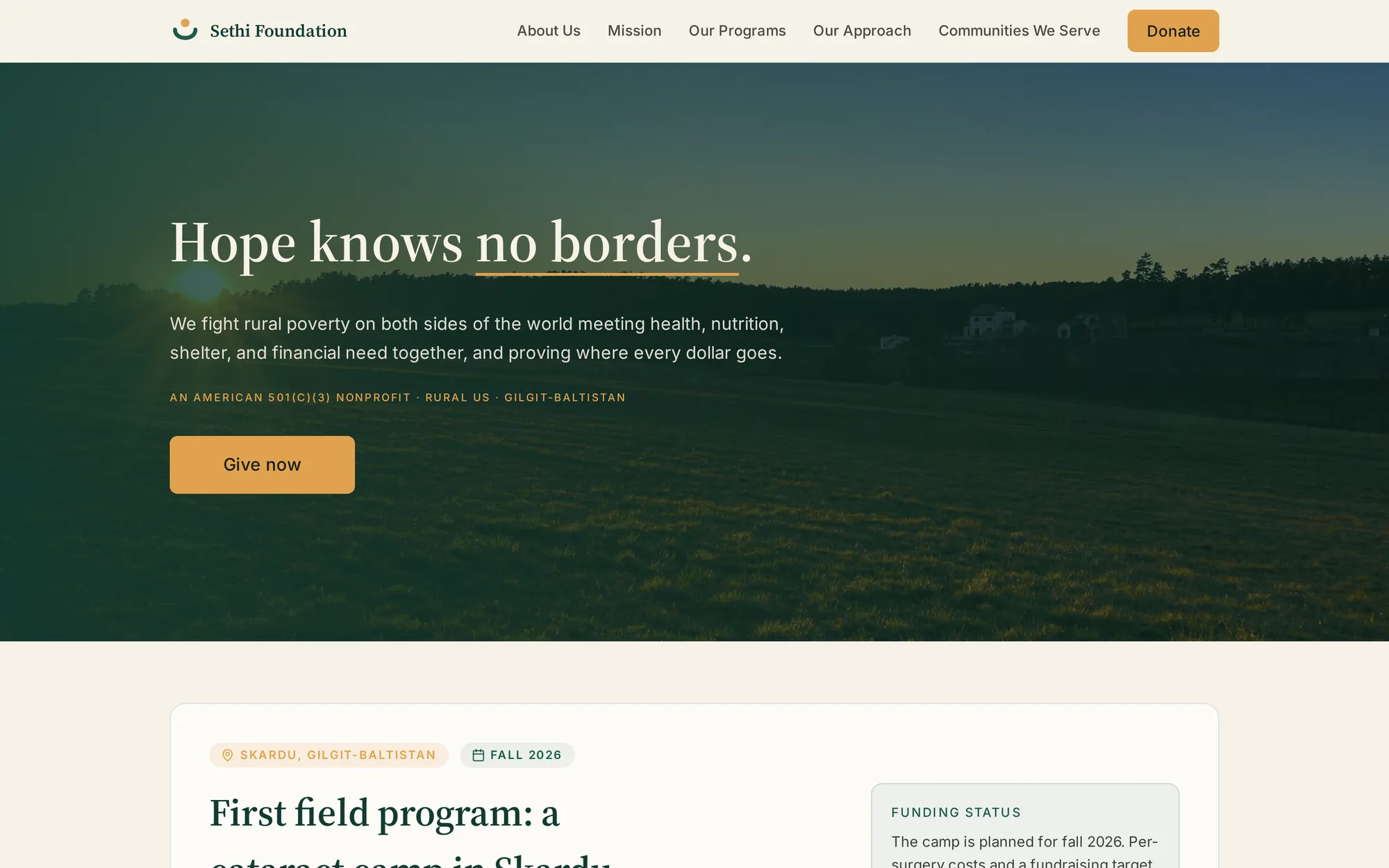
- Role
- Brand, IA, and copy — sole designer
- Timeline
- 2026 — ongoing
- Team
- Self-directed. Founder as client; board approved compliance decisions.
- Tools
- Figma · Lovable · Google Docs
What I did
Sole designer — brand strategy, jobs-to-be-done, donor personas, site architecture, and all website copy.
01 — The challenge
A young foundation, a cross-border gift, and no track record
The Sethi Foundation is a young American 501(c)(3) fighting rural poverty in two places at once: the rural United States and rural Pakistan, across four pillars — healthcare, nutrition, shelter, and financial aid. It is brand new, asking strangers to send a cross-border gift, and the core donor's gate to giving is trust rather than emotion. That's the whole design problem in one sentence.
The core donor is usually a mid-income, well-established individual, often from the Pakistani diaspora, weighing a single gift to an organisation they've just met and sending money across a border. For that person, the deepest hesitation has little to do with whether the cause matters. The real question is whether the money can be traced, and whether anyone is accountable for it. That changes the website's job. An emotional appeal that hopes people act won't hold here, because the doubt comes back as soon as the feeling fades. The site has to clear a trust gate first, and it has to do it for a gift that still has to cross a border cleanly.
There's also a clock. The site should be live ahead of the fall 2026 cataract-surgery camp in Skardu, Gilgit-Baltistan. That camp is the foundation's first field programme, and the first point at which real evidence and photography actually exist.
02 — The insight that reframed the brief
Transparency as the point of the brand, not a feature of it
The move that reframed everything was to treat transparency as the point of the brand rather than a feature of it. The thing donors most fear is the thing the foundation is structurally built to solve. Financial integrity is written into its bylaws: private inurement is forbidden, overhead is kept low, bureaucracy is minimal. The anxiety that stops the gift is the same ground the organisation is strongest on.
Transparency is the lead of the brand. The first promise, not the fine print.
Most nonprofits do the opposite. They open with an emotional appeal and bury the financials in a footer. Here the order flips: proof comes before the ask. Every decision after that, from the homepage architecture down to the tone of a single button, follows from putting proof first.
03 — Approach
A stage-gated method
I ran this end to end as the sole designer. The founder was the client, providing input and sign-off, and the board approved compliance decisions. Brand Guidelines v1 is largely complete, website copy is in active development, and validation and build are still ahead — with a soft launch targeted to the fall 2026 Skardu cataract camp (Project First Light).
Rather than jumping to visuals, the work moved through sequential, decision-gated stages. Nothing hardened before the stage beneath it was settled, and each artifact fed the next. Information architecture, content, and design all trace a straight line back to strategy.
- Founder questionnaire. Turned intent into raw material: mission in plain words, the primary audience, the single biggest hesitation, the comfort line on imagery, and how visible faith should be.
- Brand Guidelines v1. Positioning, messaging pillars, personality and voice, and the full identity system: logo, colour, type, and imagery rules.
- Jobs-to-be-Done. What each audience is actually hiring the site to do, written as outcomes rather than features.
- Donor personas. Four personas that put a face and a decision-moment on each job, framed deliberately as hypotheses to test.
- Website architecture & copy. In active development: homepage structure, navigation, and section-by-section copy, all governed by the jobs and the voice.
A discipline runs through the whole sequence: the strategy artifacts (JTBD, personas) are labelled hypotheses for donor validation, not findings. The method keeps honest about what's known versus what's assumed, so a reasoned guess never quietly hardens into fact.
04 — Brand strategy and positioning
One statement, four pillars, one deliberate call on faith
An American foundation fighting rural poverty on both sides of the world, meeting health, nutrition, shelter, and financial need together, and proving where every dollar goes.
Whole-person relief
Four needs met together, aimed at self-sufficiency rather than a band-aid.
Hope knows no borders
American-rooted, serving rural US and rural Pakistan alike.
Every dollar accounted for
Traceable giving, low overhead, integrity written into the bylaws.
Dignity first
People shown as capable, with the focus kept on outcomes rather than hardship.
On faith: A deliberate, load-bearing call: faith is part of the foundation's roots but not front-of-house. The brand welcomes faith-motivated giving without presenting as a religious organisation: an open channel rather than a labelled one. Whether that positioning helps or costs conversion is one of the sharpest things flagged for donor validation.
05 — Voice
Report, don't plead
The voice is a credible institution reporting results: calm, specific, evidence-led. For a donor who's been burned before, the calm is the strategy. Emotional pressure reads as a red flag; steady, specific proof reads as safe.
- Report, don't plead. Lead with what happened and what it cost.
- Be specific, never invented. Name places, partners, and amounts. A real number or none at all.
- Show dignity. People are capable partners, not victims to be rescued.
- Prove it. Pair every claim with evidence: an audit, a document, a photograph.
- Stay calm. Confidence over urgency. No guilt, no hype.
| Do | Don't |
|---|---|
| "This clinic now runs five days a week. Here is who staffs it and what it cost." | "Without you, these poor people have nothing." |
| "Families in the valley are rebuilding after the floods." | "We swoop in to rescue helpless villagers." |
| "Every dollar is traceable. Read our latest independent audit." | "We're the most trusted charity. 100% of your gift helps." |
06 — Identity system
What the strategy produced
The mark
A pair of open, cupped hands lifting a seed. The hands are care and shelter; the amber seed is hope and vitality, raised toward growth and self-sufficiency. It carries the brand with no words and stays legible down to a favicon.
Color
Cedar green leads. Bone and sage mist carry the backgrounds. Amber is an accent only: highlights, calls to action, and the logo seed. The restraint is the rule. If amber is everywhere, it stops meaning anything.
Cedar green
#1E5B4C
Primary — the brand colour
Pine
#123B31
Depth, footers, hovers
Amber
#E0A24E
Accent only — highlights, CTAs, logo seed
Ink
#1A1D1C
Body text
Bone
#F6F1E8
Primary background
Sage mist
#E3EAE4
Secondary surfaces, dividers
07 — From strategy to structure
Jobs-to-be-Done
The JTBD lens holds that people don't give to a nonprofit for its own sake. They hire a giving experience to make progress on a job in their own life. Four audiences were mapped (one-time donor as the make-or-break primary, then recurring donors, partner organisations, and beneficiaries), each with functional, emotional, and social jobs. Out of that map came the spine: the jobs the homepage and information architecture must serve if they serve nothing else, ranked primary donor first.
- Prove where the money goes, with an independent audit. The make-or-break trust job and the brand's own lead promise. If this isn't answered before the ask, nothing else converts.
- Answer how a US gift reaches Pakistan compliantly. The single highest-leverage answer for the expat/diaspora profile, and the one thing a generic charity can't say.
- Let the burned-before donor give from calm confidence, not guilt. Proof before the ask, dignity over pity, report over plea.
- Let the diaspora donor act on a homeland tie and be seen giving wisely. Identity and belonging: the "one org, two worlds" story they see themselves in.
- Show what a gift delivers across four pillars, then make giving fast. Concrete whole-person outcomes plus a frictionless, receipted flow.
- Keep earning trust over time so a one-time gift becomes monthly. Sustained, audited reporting that makes recurring giving feel like belonging.
08 — Putting a face on the jobs
Donor personas
Four personas turn the jobs into decision-moments, each written as trait, job story, and concrete site implication: the first-time giver, the verifier, the one reaching back, and the one giving on principle.
The first-time giver (P1, primary).
A stranger deciding in one sitting; raw trust, cleared fast and without friction, is the whole game.
The verifier (P2, diligence).
Gives only after the organisation survives active scrutiny, and wants to know what a figure actually buys.
The one reaching back (P3, diaspora).
Gives because the work is in the place their family comes from; cross-border compliance is their personal gate.
The one giving on principle (P4, faith-motivated).
Gives because their values require it, through a channel that welcomes faith without wearing a single label.
These are hypothesis personas: names and voices are illustrative, drawn from strategy rather than interviews. The open questions are built right into them. Do P1 and P2 collapse into one donor at different intensities? Are P3 and P4 separable by motivation, or are they the same diaspora-and-faith giver carrying two jobs? Naming those seams is the point, because they're the first things to test.
09 — Principles
What governed every decision
- Transparency is the lead, not a supporting detail. The brand's central strategic insight, applied everywhere.
- No fabrication, and it's a hard constraint. No invented figures, no placeholder impact counters, no unconfirmed claims. A real number or none. The brand practises internally exactly what it promises donors.
- Flag load-bearing gaps openly. Where a deliverable depends on an unconfirmed decision, surface it and offer provisional phrasing rather than paper over it.
- Dignity-first, faith-welcoming not faith-branded. Report over plea. Non-negotiable voice constraints.
- Geographic specificity. Gilgit-Baltistan named concretely instead of a generic "rural Pakistan", so the diaspora reads its own place rather than an abstract cause.
The one open, load-bearing item
How a US donation legally reaches Pakistan, and who independently audits the transfer, is pending board confirmation. It's the single highest-leverage answer on the site, and the design names it as a known gap rather than inventing an answer. Section 8 of the guidelines and the Financial Integrity page stay open until the board returns the mechanism.
10 — Where it stands, and what's next
An honest read on a pre-launch project
Done or largely done
- Brand Guidelines v1: positioning, voice, and a full identity system, with one section intentionally held open.
- JTBD map and four donor personas, produced as hypothesis deliverables for validation.
- Website copy in progress: the homepage trust-first section reviewed, navigation resolved to who we serve / our approach / our programs.
Next
- Take the trust and cross-border jobs into 6–8 donor interviews, diaspora one-time donors first, to confirm, correct, or kill the ranking before IA hardens.
- Resolve the cross-border compliance mechanism with the board, then complete Section 8 and build the Financial Integrity page.
- Capture real field photography at the fall 2026 Skardu cataract camp, replacing restraint-by-necessity with real evidence.
- Launch ahead of Project First Light.
11 — What the work demonstrates
Strategy and structure pointing the same way
What sets this apart is that it skips the usual emotional appeal and builds the whole identity around the donor's real gatekeeper: trust. That only works because the structure backs it up. The bylaws forbid private inurement, keep overhead low, and hold the foundation accountable, so the brand isn't promising something it can't deliver. Strategy and structure point the same direction.
The same discipline shows up in how the work handles its own uncertainty. Hypotheses are labelled as hypotheses. The one unresolved dependency is named out loud instead of hidden. No number is invented to fill a gap. That's the same integrity the brand promises its donors, turned inward on the design process.
Live prototype
Explore the build
Desktop
Mobile
Work-in-progress prototype, built in Lovable. Copy and content are still in active development. Open the live build ↗
Next case study
Built for the manager who can't be on-site →